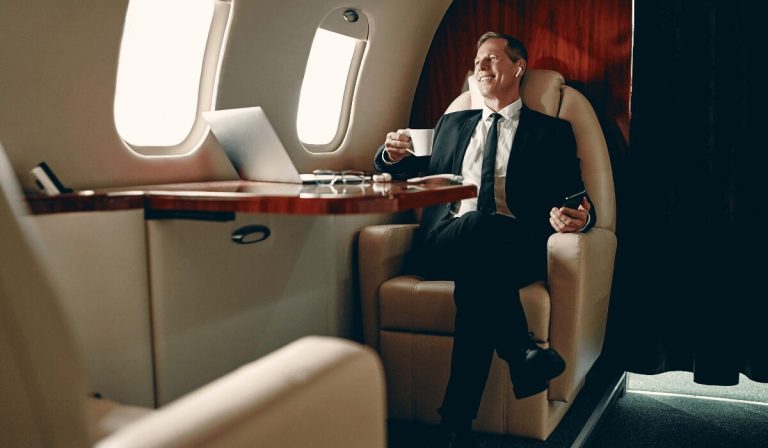
For years, private aviation has been associated primarily with luxury, exclusivity and convenience. But the role of private aviation is changing.
Increasingly, businesses, entrepreneurs, family offices and high-net-worth individuals are looking at private aviation not simply as a premium way to travel, but as a strategic tool for managing time, accessing markets and making complex travel schedules possible.
The question is no longer simply, “Why fly privately?”
It is increasingly becoming:
“What can I achieve with the time and flexibility that private aviation gives me?”
That shift is significant for the industry, and for the people who use it.
Time is becoming the real luxury
The most obvious advantage of private aviation is often described as speed. A private aircraft can, in many circumstances, get passengers from one destination to another faster than a commercial flight.
But the greater benefit is often what happens before and after the flight.
Commercial air travel can involve arriving well in advance, navigating large terminals, security queues, connections, baggage collection and ground transportation. For certain journeys, the time spent on the overall travel experience can be considerably greater than the actual time in the air.
Private aviation changes that equation.
Passengers can often arrive closer to departure, use dedicated terminals and fly from airports that are more convenient to their final destination. This can make it possible to build a much more efficient itinerary around meetings, events and other commitments.
In other words, the value of private aviation isn’t necessarily the time spent in the air.
It is the time it gives back on the ground.
Turning one day of travel into a productive business day
For business travellers, this can be particularly valuable.
Consider an executive who needs to attend meetings in three different European cities. A conventional itinerary might require multiple commercial flights, connections or overnight stays.
With the right private aircraft and itinerary, it may be possible to visit several destinations in a single day and return home that evening.
That doesn’t just save flying time. It can potentially mean:
- More meetings completed in a single trip
- Fewer overnight stays
- Less time spent travelling between airports and city centres
- Greater control over the schedule
- More time available for clients, colleagues or family
- Reduced disruption to the working week
The financial value of that time will obviously differ from one traveller to another. But for business leaders, investors and senior executives, the ability to make more effective use of a working day can be an important consideration.
Reaching destinations commercial aviation doesn’t serve directly
One of the less obvious advantages of private aviation is the number of airports available.
Commercial airlines tend to concentrate their networks around major airports and established routes. Private aircraft, subject to aircraft performance, airport restrictions and operational considerations, can access a much wider range of regional airports.
That can dramatically change an itinerary.
Instead of flying into a major international airport and then spending another hour or two travelling by road, a private aircraft may be able to land closer to the actual destination.
For businesses operating across multiple regions, this can be particularly useful.
It can also open up destinations that are poorly served by scheduled airlines – whether that means a manufacturing facility, regional office, investment opportunity, second home or leisure destination.
More than one trip in a single itinerary
Another increasingly important use of private aviation is the ability to combine multiple commitments into one journey.
Rather than making several separate trips, travellers can potentially create an itinerary that connects multiple destinations.
For example:
London → Milan → Geneva → Paris → London
Instead of treating each meeting as a separate journey, a carefully planned private itinerary can turn several commitments into one continuous trip.
This can be particularly valuable for:
- Investment meetings
- Corporate site visits
- Property inspections
- International negotiations
- Events and conferences
- Family office operations
- Sporting and entertainment commitments
Of course, not every itinerary will be operationally or financially sensible. Aircraft availability, airport slots, crew duty limitations, weather and other operational factors all have to be considered.
But the flexibility to design the journey around the traveller, rather than around an airline timetable, is one of private aviation’s defining advantages.
Productivity doesn’t stop when the aircraft takes off
There is another factor that is becoming increasingly important: what passengers can do while travelling.
For many senior executives and business owners, travel time isn’t necessarily lost time when the environment allows them to work privately and securely.
Meetings can take place. Documents can be reviewed. Calls can be made. Strategy discussions can continue.
It’s not only about business
The strategic value of private aviation isn’t limited to corporate travel.
Families with homes in different countries, individuals attending major sporting or cultural events, and travellers visiting destinations with limited commercial connectivity can all benefit from greater control over their itinerary.
For leisure travellers, that may mean leaving later, arriving closer to the final destination or combining several destinations into a single trip.
The underlying principle remains the same:
Private aviation allows the journey to be built around the passenger, rather than the passenger building their plans around the journey.
The rise of the strategic private aviation user
This doesn’t mean that luxury has disappeared from private aviation. It remains an important part of the experience.
But it does suggest that the conversation is becoming more sophisticated.
Private aviation is increasingly being evaluated according to questions such as:
- How much time can I save?
- How many meetings can I attend?
- Can I reach destinations that commercial airlines don’t serve?
- Can I combine several trips into one?
- How much disruption can I remove from my schedule?
- Can I be productive while travelling?
- Does charter, fractional ownership or another access model make the most sense for my travel pattern?
That last question is particularly important.
Private aviation isn’t a single product. On-demand charter, membership, jet cards, fractional ownership and whole-aircraft ownership all suit different travel requirements.
The right solution depends on factors including annual flight hours, destinations, passenger numbers, frequency, flexibility and how far in advance flights are normally planned.
The best approach is therefore not necessarily to find the most expensive or prestigious aircraft.
It is to find the right aviation solution for the mission.
The future of private aviation is about time
The private aviation industry is evolving.
As business becomes increasingly international and schedules become more demanding, the ability to control how and when people travel can become a genuine strategic advantage.
For some passengers, private aviation will always be about comfort and luxury.
For others, it is becoming something more fundamental: a way of buying back time, increasing flexibility and making complex travel possible.
And that may be the most important shift of all.
The future of private aviation isn’t simply about flying better. It’s about using travel more intelligently.
The real luxury isn’t necessarily the aircraft.
It’s having more control over your time.
Book with BOOKAJET today:
Call: +44 (0) 1252 399600
Email: fly@bookajet.com
WhatsApp: +44 (0) 791 732 0324
Visit: www.bookajet.com/contact-us
Follow us on Instagram: @bookajet & Facebook: Bookajet